
Environmental Humanities for the 21st Century
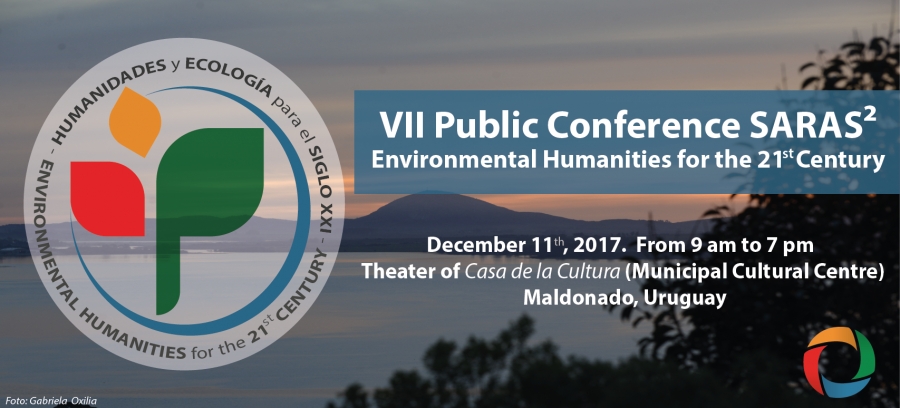
VII Public Conference SARAS2 – December 11th 2017, Theater of “Casa de la Cultura” (Municipal Cultural Centre) Maldonado, Uruguay
Foundation
The role that beliefs, values, culture, and the arts play, or may play in fostering change in the interaction between humans and nature is a topic back at the center of attention among the many forms of environmentalism. There is an increasing consensus that scientific and economic arguments are not having enough impact in public debates. Environmental crises have led us to the awareness that as humans we are inserted in communities–with other species and objects–that emerge from the entanglement of these agential beings. If that is the case, then, in which diverse ways and in what multiple scenarios we could re-think collaboratively, among disciplines and cultures, human identities and responsibilities?
When confronting, analyzing, and articulating 21st-century challenges, this question has become a priority in the political agenda of social movements. Without any doubt, it has also become a priority for the Humanities, the Social Sciences and Political Science in universities and think tanks in many countries. Furthermore, it can even be found too in the agenda of state agencies and governmental institutions. The concept of Environmental Humanities names and fosters visibility to a significant diversity of initiatives reflecting on the power of culture and the arts as agents of or media for transformation. In consequence, the Environmental Humanities are as well an effort for intervening on public debates where the properties of the relation between humans and nonhumans get discussed by different stakeholders, or where responses to environmental change are developed by communities. In fact, the Environmental Humanities aspire to promote sustainability and resilience by producing knowledge with strategic value for solving specific environmental problems.
The Environmental Humanities search for, in the history or current present of different peoples, alternative ways of conceiving the association and interaction between humans and nonhumans. And their findings and reflections are disseminated through different fields such as environmental philosophy, environmental history, ecocriticism, political ecology, ecofeminism, environmental anthropology, philosophy and history of science, the theology of Creation, etc. These fields, however, are not left untouched by another significant problem. Like many other disciplines and fields whose objects of study are “the social” and/or “cultural artifacts,” the Humanities conventionally define theirs under the assumption that there is a substantial ontological dichotomy between nature and culture, and between subject and object. The Environmental Humanities, nevertheless, cannot incur in such incoherence, and have no choice but to revise these disciplinary foundations. Literary and cultural ecocriticism, for instance, is forced into this due to the influence of certain art, in a variety of media and genre, and from different times, that do not think of itself as merely the expression of a human subject in a code exclusively human. Rather, in such cases, art thinks of itself as events in which humans and nonhumans converge in the process of imagination, materialization, and/or reach of the artwork.
SARAS, in accordance to our vision and mission, is committed to the development, visibility, and recognition of the Environmental Humanities as a key conceptual tool for advancing the analysis and understanding of the complex problems that affect contemporary society.
“Environmental Humanities for the 21st Century” has been selected as the theme for our Seventh Public Conference in 2017. It will bring together scholars in the humanities, writers, and social and natural scientists with the purpose of discussing art, literature, film and culture in general from an ecological perspective.
Objectives
Organizers
Organizing team: Jorge Marcone (Rutgers University- SARAS Institute), Laurie Beth Clark (University of Wisconsin-Madison – SARAS Institute), Jesse Kercheval (University of Wisconsin-Madison – SARAS Institute) and Marten Scheffer (Wageningen University – SARAS Institute).
Local organizing team: Paula Bianchi (SARAS Institute), Néstor Mazzeo (CURE- Udelar, SARAS Institute), Mariana Meerhoff (CURE – SARAS Institute) and Micaela Trimble (SARAS Institute).