
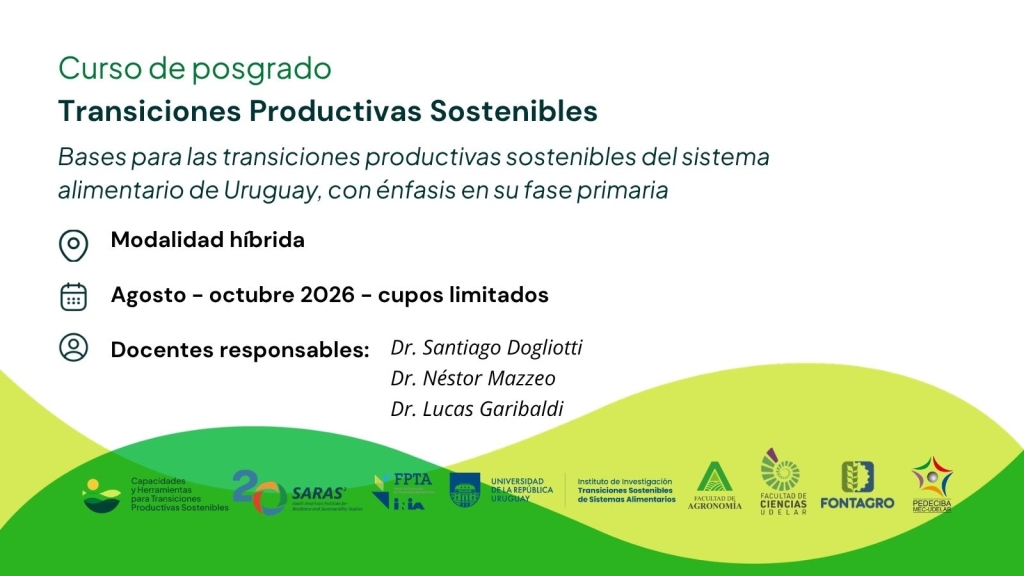
Postgraduate Course in Sustainable Productive Transitions 2026
Foundations for sustainable transitions in Uruguay’s food systems, with a focus on the primary sector.
Goals
General
To examine the conceptual and scientific foundations upon which sustainable transition processes in food systems can be promoted, particularly at the level of agroecosystems. To discuss strategies and tools for evaluating current systems and promoting change in transdisciplinary contexts.
Specific
- To explore the current challenges facing the sustainability of food systems in general and agroecosystems in particular.
- To identify the main economic, social and political factors that promote and hinder sustainable transition processes in national and international contexts.
- To introduce the theoretical and practical foundations for promoting sustainable transitions in agroecosystems.
- To introduce the theoretical and practical foundations for monitoring and evaluating sustainable transition processes and related public policies.
Justification
The expansion of homogeneous landscapes resulting from agricultural production has been a major driver of biodiversity loss, climate change and land degradation. There is an urgent need to transition towards multifunctional landscapes that provide abundant and nutritious food, whilst also delivering other essential contributions to a good quality of life. However, implementing this process requires appropriate economic studies and projections, the involvement of multiple stakeholders, and the co-development of tools and capacities.
Furthermore, it is important to bear in mind that changes in food production, distribution and consumption systems involve multiple dimensions that operate simultaneously across different spatial and temporal scales. Within the temporal dynamics of food systems, periods of slow and gradual change alternate with phases of profound and rapid transformation.
The mechanisms that determine the alternation between the persistence and transformation of food systems can be analysed to improve our understanding of their structural and functional aspects. Connectivity and the exchange of different types of knowledge are essential for expanding capacities and enhancing the potential of the actors involved (producers, technicians, academics, politicians).
This type of analysis generally combines two major theoretical frameworks drawn from the fields of socio-ecological systems and socio-technical transitions. This combination enables us to understand past trajectories of change, anticipate transformations and design desired transitions.
Changes in agricultural practices towards more sustainable production systems are seen as the result of a collective learning process involving all stakeholders in the change process, including researchers. This process is known as co-innovation, an approach that combines complex systems theory, social learning, and dynamic project monitoring and evaluation to stimulate the strategic reorientation of production systems.
In this context, we will discuss guidelines and principles for implementing sustainable transitions at different levels, based on scientific knowledge and our professional experience.
Methodology
The course is structured into 3 modules and 17 thematic units, each comprising 2 hours of theory and discussion, reading of the recommended literature, and a continuous assessment questionnaire.
There will be two face-to-face sessions at the start and end of the course: on 4 August at the Faculty of Agronomy – Sayago, and on 1 October at the Saras Institute in Bella Vista, Maldonado.
The remaining thematic units will be delivered online.
Assessment will be per module, plus a final group project.
Teachers
Cristina Zubriggen, Esteban Jobbágy, Óscar Blumetto, Gabriel Oyhantcabal, Guillermo Sena, José Paruelo, Lucas Garibaldi, Matilda Baraibar, Miguel Carriquiri, Miguel Sierra, Néstor Mazzeo, Silvana Juri, Eduardo Viola, Pablo Tittonell, Paulo Petersen, Santiago Dogliotti, Tomás Milani, Walter Oyhantcabal, Walter Baethgen, Federico Bizzozero and Carolina Balian.