
Interdisciplinary Congress in Montevideo
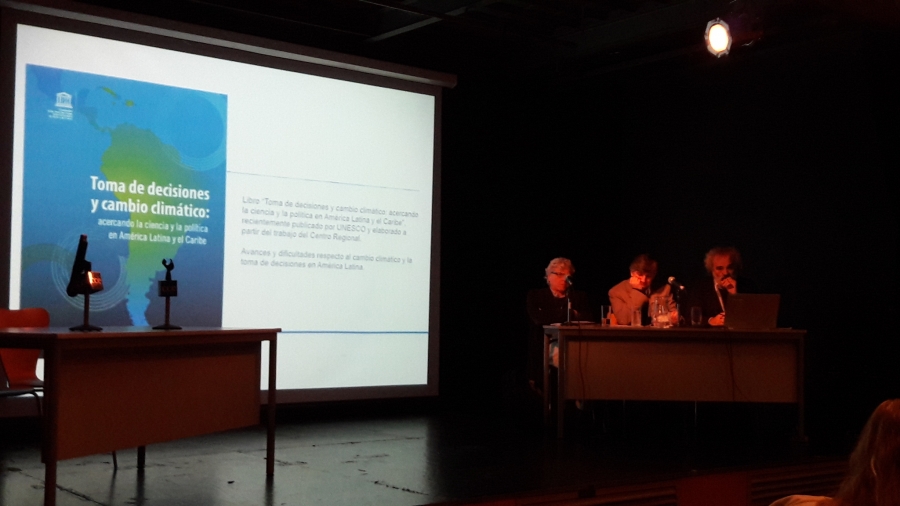
The 1st Latin American Congress on Research and Interdisciplinary Higher Education took place in Montevideo, Uruguay on September 2016.
Members of the SARAS Institute spoke about the Management of Water Resources in Uruguay, Advances, Limitations and Challenges. The presentation was based on a study that a large group of researchers carried out. It explores the main challenges faced today in the management of this resource.
At the same time as co-authors of the book Decision Making and Climate Change. Bridging the Gap Between Science and Policy in Latin America and the Caribbean (published in September by UNESCO), the Institute participated in a round table discussion “Challenges Faced to Integrate Climate Change to the Decision Making Processes.” Pedro Jacobi (IEE-USP, Brazil) and Daniel Ryan (ITBA, Argentina) also participated.
Summary of Water Resource Management in Uruguay
Water management in Uruguay faces considerable challenges due to changes occurring in the last 15 years. The most significant changes have to do with the structure of governance, transformation in land use and its effects on ecosystem services, crisis in the drinking water supply, and new irrigation methods aiming to increase production and reduce vulnerabilities under conditions of extreme drought.
Uruguay went from the command-control to integrated management of water resources starting with the last constitutional reform in 2004 and the implementation of a Water Policy in 2009. The latter referred to as Law No. 18.610 identified multiple players acting at three different levels:
The transition from one management paradigm to another has coincided with three changes in government. This has implied that the implementation and transformation of the legal framework and norms has suffered inertia and multiple challenges. A list of the main ones follows:
Uruguay is very far from being prepared to implement more modern paradigms such as adaptive management. This is because Uruguay lacks a national program for monitoring the quantity and quality of water. It also is behind in connecting government entities to exchange information being generated, and a will to improve management.
There is lack of information on the current status of many of our existing resources. Therefore, we are unable to evaluate the incidence of different types of land use, the effects of present land-use and management plans, or the incorporation of good practices to the agriculture, livestock or forestry sectors, among other issues.
The study explores and supports a number of strategies for promoting the establishment of an integrated management approach and the transition towards adaptive management models. The most important are the following:
The proposed alternatives seek to promote social learning, to achieve greater adaptability and resilience of the resource and the associated ecosystem services to current and future pressures.