
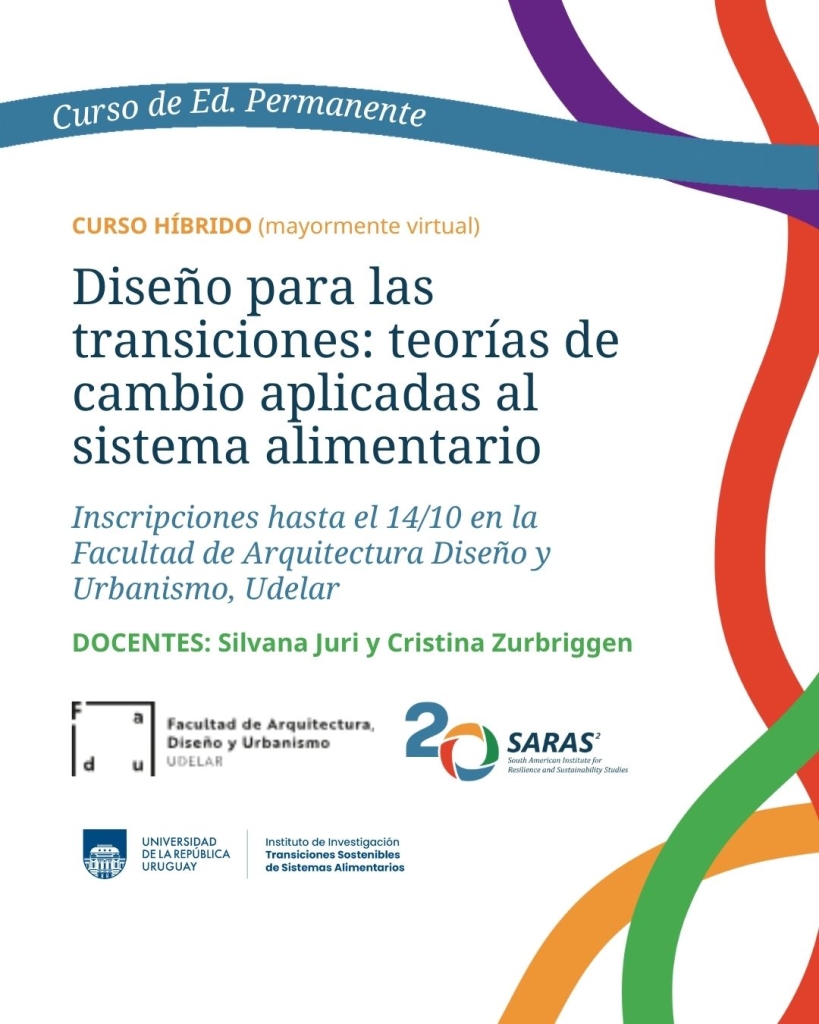
Designing for transitions: theories of change applied to the food system
2026 Edition | 20 years of SARAS
CONTENTS
Objectives:
This course offers an introduction to the Design for Transitions (DxT) approach and an in-depth exploration of how to apply theories of change to complex issues, in this case relating to food systems. The course aims to provide a series of conceptual and methodological tools, grounded in design, which facilitate the integration of knowledge, the convergence of disciplinary fields and practice, within a problem-led action research framework. The objectives include:
1) To provide an introduction to an emerging systemic approach (DxT) for the analysis of and intervention in complex issues such as those relating to the food system and its transformation.
2) To equip participants with analytical skills and practical collaborative tools to enable the co-production of knowledge, creativity and the learning required to design change.
3) To create a transdisciplinary space for reflective learning and the exchange of knowledge, with the aim of fostering critical perspectives, collective imaginaries and collaborative actions to develop alternatives for possible and appropriate food futures.
4) To adopt and prototype a Theory of Change (as both a tool and an outcome) to facilitate and evaluate transition processes towards sustainable food systems (e.g. with impacts on: ways of life, behaviours, public policies, etc.)
Contents:
The course content is structured around three core themes, which are developed through a combination of theoretical and methodological introductions, discussions and practical exercises, as follows:
Focus 1: Introduction, contextualisation and problem definition (framework):
a- Introduction to the course and its participants, and thematic contextualisation on food systems, complex problems and transformations.
b- Presentation of the Design for Transitions approach: a transdisciplinary conceptual and methodological framework. Key tools and the start of group work on problem definition.
c- The Theory of Change approach: Introduction to the approach as both a tool and an output. Narratives, reframing and assumptions, and an introduction to and familiarisation with the use of the Causal Layered Analysis (CLA) tool.
Focus 2: In-depth exploration of collaborative tools (reframing):
a- Introduction to anticipatory/futuristic approaches: visions and trajectories of change. Tools for envisioning the future.
b- Backcasting and the development of intervention ecologies for the transition.
Focus 3: Theories of change and transformative evaluation (intervention and observation):
a- Transformative evaluation: an adaptive and transdisciplinary model
b – Presentation of the results of the theories of change developed, course conclusion and evaluation.
CONDITIONS
SARAS T-Lab and the Postgraduate and Continuing Education Service, Faculty of Architecture, Design and Urban Planning (FADU).
Seminar-Workshop: Design for transitions: theories of change applied to the food system
Course leader:
Gº3 Silvana Juri (FADU, Udelar / SARAS Institute)
Teaching Team:
Gº4: Cristina Zurbriggen (FCS-Udelar / SARAS Institute)
Course delivery: Blended learning
Attendance and assessment requirements: The course is passed with 80 per cent attendance at classes (in-person and online), and upon submission of a final group assignment (with a minimum grade of ‘Pass’).
Total hours: 45 hours
Classroom hours: 23 hours (including face-to-face and online classes).
Starts in mid-October (4th term)
Recommended prior knowledge:
The course is open to a wide audience given its transdisciplinary approach; however, it is aimed at those with intermediate-level prior knowledge (or experience) – gained through study or professional practice – of: food systems, food production and/or consumption, human nutrition, socio-ecological systems, public policies relating to the food sector, design and project-based research, inter- and transdisciplinarity, and sustainability.
Teaching methodology:
This is a theoretical and practical course structured around theoretical presentations, group discussions and the development of group projects and activities in a ‘workshop’ format. Digital platforms will be used to collectively foster reflection, analysis, discussion and the creation of outputs as a result of the learning process (practical component). The course is conceived as an action-research platform that weaves together the participants’ personal and material experiences, alongside a collaborative working experience in both virtual and face-to-face settings, facilitated by the three lecturers in charge of the course, from an inter- and transdisciplinary perspective.
Assessment methods:
Assessment will take into account attendance at classes, participation in class, and the completion and submission of the final assignment (a group project spanning the entire course).
ENQUIRIES: teoriasdecambioitssa@